Sort by:
882 of 1932 products
882 of 1932 products

“A riotous novel about a farewell party that celebrates all of life’s emotions—big and small—while marking the arrival of an exciting new voice in fiction.” —Steven Rowley, New York Times bestselling author of The Celebrants
For readers of Less and The Wedding People—a rollicking, big-hearted story of long-lost love, friendship, and a life well-lived, set at a Florida retirement resort for queer women, on the last day of resident Hannah Cardin’s life.
It’s 2067 and Florida is partially underwater, but even that can’t bring down the residents of Palm Meridian Retirement Resort, a utopian home for queer women who want to revel in their twilight years. Inside, Hula-Hoopers shimmy across the grass, fiercely competitive book clubs nearly come to blows, and the roller-ski team races up and down the winding paths. Everywhere you look, these women are living large.
Hannah Cardin has spent ten happy years under these tropical, technicolor skies, but after receiving a terminal cancer diagnosis, she has decided that tomorrow morning she will close her eyes for the very last time. Tonight, however, Hannah and her raucous band of friends are throwing one hell of an end-of-life party. And with less than twenty-four hours left, Hannah is holding out for one final, impossible thing…
Amongst the guest list is Sophie, the love of Hannah’s life. They haven’t spoken since their devastating breakup over forty years ago, but today, Hannah is hoping for the chance to give her greatest love one last try.
As Hannah anxiously awaits Sophie’s arrival, her mind casts back over the highs and lows of her kaleidoscopic life. But when a shocking secret from the past is revealed, Hannah must reconsider if she can say goodbye after all.
Spanning the course of a single day and seventy-odd years, and bursting with irresistible hope, humor, and wisdom, this one-of-a-kind novel celebrates the unexpected moments that make us feel the most alive.

"Pantomime is a fantastical, richly drawn, poignant take on a classic coming-of-age story . . . a vibrant tale told with surety and grace" — Leigh Bardugo
From the USA Today-bestselling author of Dragonfall comes a fantasy trilogy about a circus aerialist's quest to escape his past and decipher the magical prophecy that will shape his future
In a land of lost wonders, the past is stirring once more . . .
Micah runs away from a debutante’s life at home and joins the circus, harboring two secrets–one: he was born between male and female, and two: he may have powers last seen in mysterious beings from an almost-forgotten age.
Micah discovers the joy of flight as an aerialist, courting his trapeze partner, Aenea, and confiding in the mysterious white clown, Drystan. He finally feels free. But the circus has a dark side, and Micah’s past isn’t done with him.
Meanwhile, the strange 'ghost' of a woman with damselfly wings whispers to Micah that only he can help magic return to the realm, and he fears she may be right…
Micah has much to learn, and he must do it quickly—before his past and future collide, with catastrophic consequences.
Pantomime is a gorgeous and inventive fantasy with queer elements, inspired by Victorian Scotland. L.R. Lam weaves a coming-of-age tale, stirrings of first love, and prophetic whispers into this unforgettable first installment of the Micah Grey series.

This acclaimed post-apocalyptic novel of hope and terror from an award-winning author "pairs well with 1984 or The Handmaid's Tale" and includes a foreword by N. K. Jemisin (John Green, New York Times).
When global climate change and economic crises lead to social chaos in the early 2020s, California becomes full of dangers, from pervasive water shortage to masses of vagabonds who will do anything to live to see another day. Fifteen-year-old Lauren Olamina lives inside a gated community with her preacher father, family, and neighbors, sheltered from the surrounding anarchy. In a society where any vulnerability is a risk, she suffers from hyperempathy, a debilitating sensitivity to others' emotions.
Precocious and clear-eyed, Lauren must make her voice heard in order to protect her loved ones from the imminent disasters her small community stubbornly ignores. But what begins as a fight for survival soon leads to something much more: the birth of a new faith . . . and a startling vision of human destiny.

The acclaimed graphic novel adaptation of Octavia E. Butler’s groundbreaking dystopian novel, Parable of the Sower, is a don't-miss classic that resonates today more than ever. As The Washington Post noted: "A 1993 dystopian novel imagined the world in 2024. It’s eerily accurate."
This Hugo Award Winner for Best Graphic Story or Comic is the follow-up to Kindred, a #1 New York Times bestseller.
In this graphic-novel adaptation of Octavia E. Butler’s Parable of the Sower by Damian Duffy and John Jennings, the award-winning team behind Kindred: A Graphic Novel Adaptation, the author portrays a searing vision of America’s future.
In the year 2024, the country is marred by unattended environmental and economic crises that lead to social chaos. Lauren Olamina, a preacher’s daughter living in Los Angeles, is protected from danger by the walls of her gated community.
In a night of fire and death, what begins as a fight for survival soon leads to something much more: a startling vision of human destiny . . . and the birth of a new faith.
“Alarmingly prescient and relevant. This accessible adaptation is poised to introduce Butler’s dystopian tale to a new generation of readers.” —Publishers Weekly
“The graphic novel is faithful to Butler, yet still fresh in its world building.” —USA Today
Includes an introduction by SFWA Grand Master Nalo Hopkinson
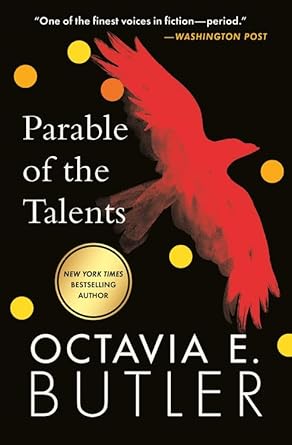
Originally published in 1998, this shockingly prescient novel's timely message of hope and resistance in the face of fanaticism is more relevant than ever.
In 2032, Lauren Olamina has survived the destruction of her home and family, and realized her vision of a peaceful community in northern California based on her newly founded faith, Earthseed. The fledgling community provides refuge for outcasts facing persecution after the election of an ultra-conservative president who vows to "make America great again." In an increasingly divided and dangerous nation, Lauren's subversive colony--a minority religious faction led by a young black woman--becomes a target for President Jarret's reign of terror and oppression.
Years later, Asha Vere reads the journals of a mother she never knew, Lauren Olamina. As she searches for answers about her own past, she also struggles to reconcile with the legacy of a mother caught between her duty to her chosen family and her calling to lead humankind into a better future.
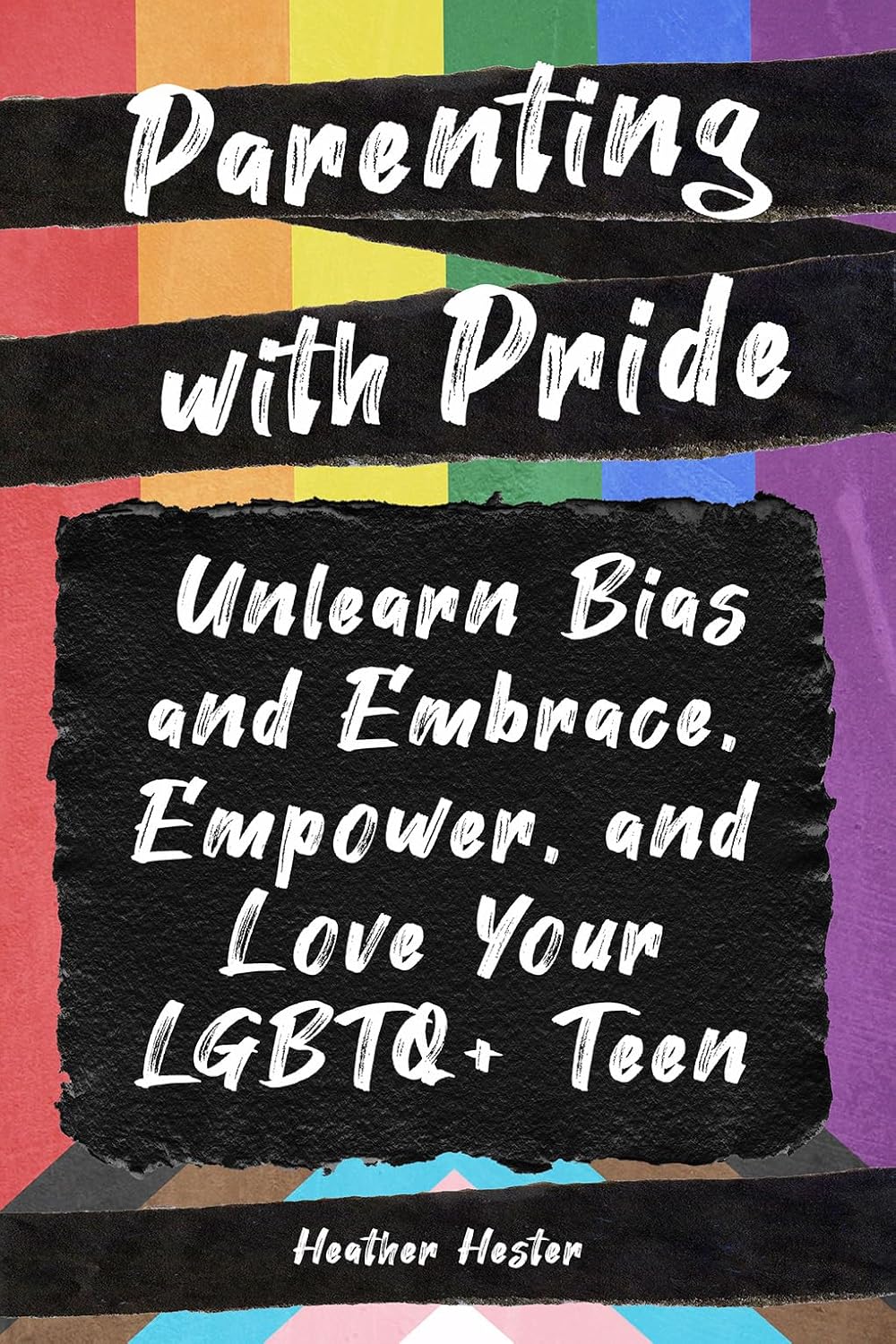
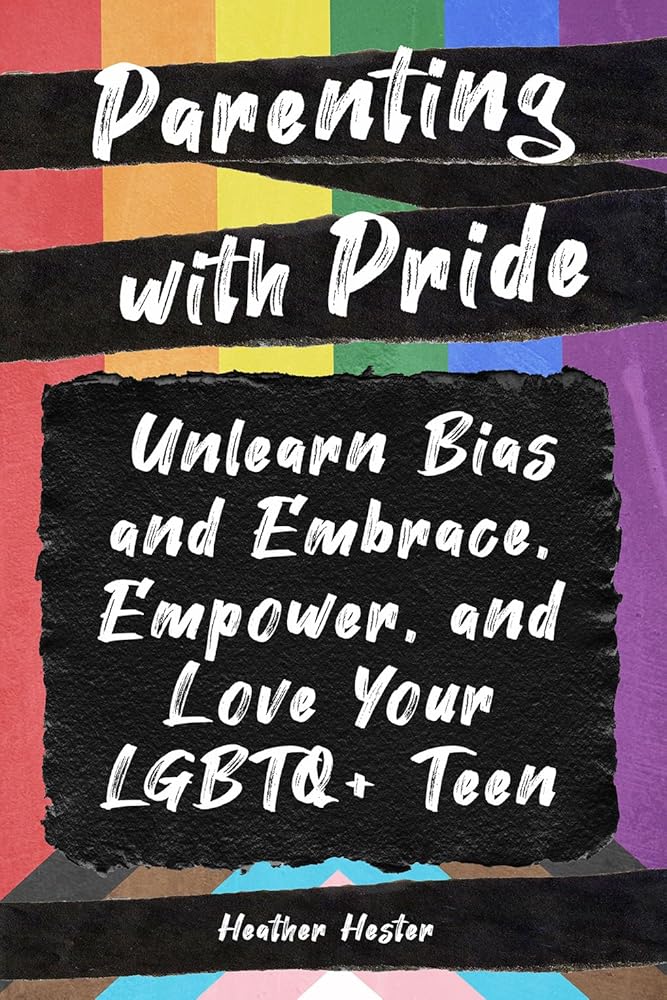
Parenting with Pride: Unlearn Bias and Embrace, Empower, and Love Your LGBTQ+ Teen
$18.99
Unit price perParenting with Pride: Unlearn Bias and Embrace, Empower, and Love Your LGBTQ+ Teen
$18.99
Unit price perThe ultimate LGBTQ parenting handbook, guiding parents and caregivers through transformative steps of Embrace, Educate, Empower, and Love so they can support their teen with open arms and hearts.
Your kid just came out to you, and amid the flurry of emotion or worry you might feel, you know you would do anything to protect their health and happiness. And you are not alone! Heather Hester, coach, advocate, and host of the #1 rated podcast, Just Breathe: Parenting Your LGBTQ Teen, combines an honest retelling of her own son’s coming-out experience with wide-ranging research, conversations with dozens of professionals, and the unique experiences of other families to provide the ultimate guidebook for parents embarking on this journey.
In Parenting with Pride: Unlearn Bias and Embrace, Empower, and Love Your LGBTQ+ Teen, Hester provides parents and caregivers with four transformations that gently, but purposefully, walk them through the four pillars toward fully supporting and loving your LGBTQ+ child: Embrace, Educate (or Unlearn), Empower, Love.
With trustworthy information and an accessible, straightforward plan, Parenting with Pride provides actionable yet profound tools and mental shifts to help parents support their teens and themselves and to be a catalyst for change in their communities.

By: Isabel Miller (Author), Emma Donoghue (Introduction), 2005, Paperback (Little Sister's Classics #3)
“A remarkable story.”—Publishers Weekly
Set in the nineteenth century, Isabel Miller’s classic lesbian novel traces the relationship between Patience White, an educated painter, and Sarah Dowling, a cross-dressing farmer, whose romantic bond does not sit well with the puritanical New England farming community in which they live. They choose to live together and love each other freely, even though they know of no precedents for their relationship; they must trust their own instincts and see beyond the disdain of their neighbors. Ultimately, they are forced to make life-changing decisions that depend on their courage and their commitment to one another.
First self-published in 1969 in an edition of one thousand copies, the author hand-sold the book on New York street corners; it garnered increasing attention to the point of receiving the American Library Association’s first Gay Book Award in 1971. McGraw-Hill’s version of the book a year later brought it to mainstream bookstores across the country.
Patience & Sarah is a historical romance whose drama was a touchstone for the burgeoning gay and women’s activism of the late 1960s and early 1970s. It celebrates the joys of an uninhibited love between two strong women with a confident defiance that remains relevant today.
This edition features an appendix of supplementary materials about Patience & Sarah and the author, as well as an introduction by Emma Donoghue, the Irish novelist whose numerous books include the contemporary Dublin novels Stirfry and Hood, the latter of which won the ALA’s Gay and Lesbian Book Award in 1995.
Little Sister’s Classics is an Arsenal Pulp Press imprint dedicated to reviving lost and out-of-print gay and lesbian classic books, both fiction and nonfiction. The series is produced in conjunction with Little Sister’s Books, the heroic gay Vancouver bookstore well-known for its anti-censorship efforts.
Isabel Miller was the author of numerous novels, including two under her real name, Alma Routsong. She died in 1996.
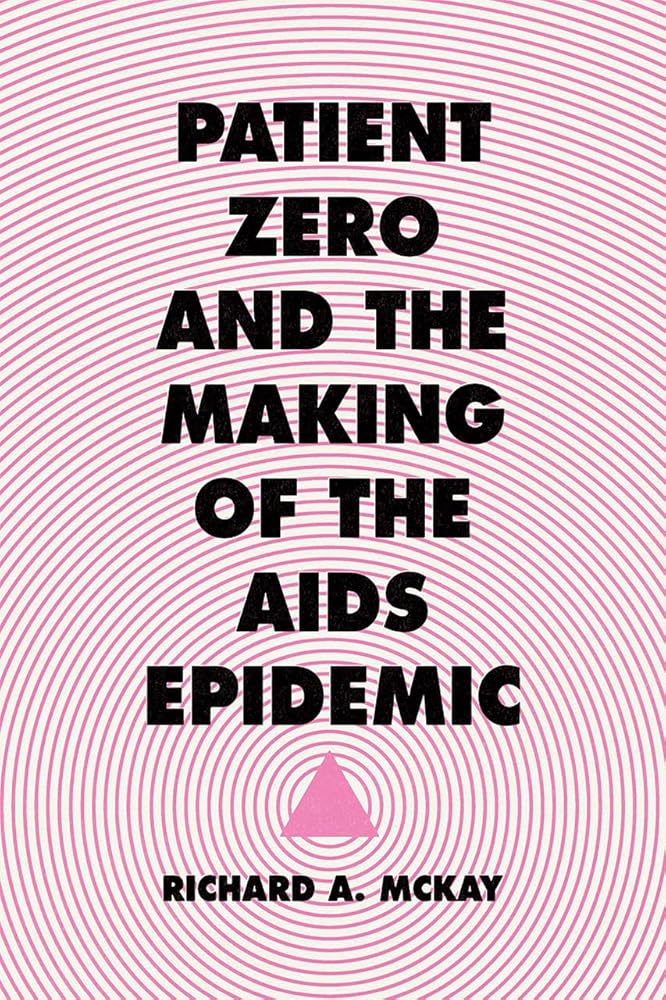
Now an award-winning documentary feature film
The search for a “patient zero”—popularly understood to be the first person infected in an epidemic—has been key to media coverage of major infectious disease outbreaks for more than three decades. Yet the term itself did not exist before the emergence of the HIV/AIDS epidemic in the 1980s. How did this idea so swiftly come to exert such a strong grip on the scientific, media, and popular consciousness? In Patient Zero, Richard A. McKay interprets a wealth of archival sources and interviews to demonstrate how this seemingly new concept drew upon centuries-old ideas—and fears—about contagion and social disorder.
McKay presents a carefully documented and sensitively written account of the life of Gaétan Dugas, a gay man whose skin cancer diagnosis in 1980 took on very different meanings as the HIV/AIDS epidemic developed—and who received widespread posthumous infamy when he was incorrectly identified as patient zero of the North American outbreak. McKay shows how investigators from the US Centers for Disease Control inadvertently created the term amid their early research into the emerging health crisis; how an ambitious journalist dramatically amplified the idea in his determination to reframe national debates about AIDS; and how many individuals grappled with the notion of patient zero—adopting, challenging and redirecting its powerful meanings—as they tried to make sense of and respond to the first fifteen years of an unfolding epidemic. With important insights for our interconnected age, Patient Zero untangles the complex process by which individuals and groups create meaning and allocate blame when faced with new disease threats. What McKay gives us here is myth-smashing revisionist history at its best.

Open pedagogy is teaching and learning practices and environments that promote equity, collaboration, and innovation and invite students to create and share knowledge with future publics, often in association with the use of open educational resources (OER).
Pedagogy Opened: Innovative Theory and Practice seeks to advance the study of open and innovative pedagogy through the belief that their impact and reach are increased by research on and analysis of the theory and practice of open pedagogy across the disciplines and via multiple modalities.
In this first volume of Pedagogy Opened, seven author teams explore and share their work with open pedagogy in a variety of ways, including through research, practice, and autoethnographic reflection.

By: Vincent Anioke (Author), 2024, Paperback
Finalist, Dayne Ogilvie Prize for LGBTQ2S+ Emerging Writers (Writers' Trust of Canada)
A beautifully imagined story collection set largely in Nigeria that explores themes of masculinity and repressed desires through the lens of (un)conditional love
In this stunning debut story collection set largely in Nigeria, questions abound: What happens when we fall short of society’s—and our own—expectations? When our personal desires conflict with the duties we are bound to? The characters in Perfect Little Angels confront these dilemmas and more in these brilliantly imagined tales.
In a boarding school, tensions brew between students and vengeful staff. An addict seeks a fresh start in pottery class. A man returns home from university abroad with confessions that unravel his mother’s world. Amid winter storms, a ghost delights her grief-stricken partner. And atop a hill surrounded by rot and garbage, two lovers dare to embark on a secret, dangerous romance. Human desires—for connection, salvation, and understanding—imbue these deeply Nigerian stories with universal resonance.
In Vincent Anioke’s tenderly written stories, characters seek love in different permutations from teachers, parents, dead partners, and even God. Perfect Little Angels is a nuanced exploration of masculinity, religion, marginalization, suppressed queerness, and self-expression through the lens of (un)conditional love.

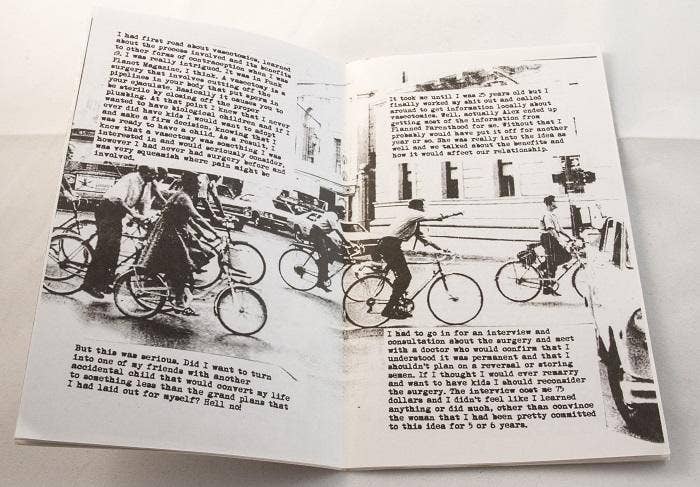
Zine / pamphlet. Published by Microcosm! Joe Biel strives to find logic, purpose, and meaning in his existence once again. This issue is about friends having accidental babies by the boatload and his resulting vasectomy to prevent himself from befalling the same fate. Plenty of details about seeking out a vasectomy, the actual surgery, and the reasons why. It's probing and personal and has the usual slice of life reality. Also includes roommate reviews supplement #4 covering the period of 2001 living at the Onramp.


“Perceptive and witty—like a Sally Rooney novel set in Southern California.” —Star Tribune (Minneapolis)
“It’s this author’s best work yet. A Sapphic roller-coaster ride.” —Kirkus Reviews (starred review)
A controversial LA author attempts to revive her career and finally find true love in this hilarious nod to 1950s lesbian pulp fiction.
Having recently moved both herself and her formidable perfume bottle collection into a tiny bungalow in Los Angeles, mid-list author Astrid Dahl finds herself back in the Zoom writer’s group she cofounded, Sapphic Scribes, after an incident that leaves her and her career lightly canceled. But she temporarily forgets all that by throwing herself into a few sexy distractions—like Ivy, a grad student researching 1950s lesbian pulp who smells like metallic orchids, or her new neighbor, Penelope, who smells like patchouli.
Penelope, a painter living off Urban Outfitters settlement money, immediately ingratiates herself in Astrid’s life, bonding with her best friends and family, just as Astrid and Ivy begin to date in person. Astrid feels judged and threatened by Penelope, a responsible older vegan, but also finds her irresistibly sexy.
When Astrid receives an unexpected call from her agent with the news that actress and influencer Kat Gold wants to adapt her previous novel for TV, Astrid finally has a chance to resurrect her waning career. But the pressure causes Astrid’s worst vice to rear its head—the Patricia Highsmith, a blend of Adderall, alcohol, and cigarettes—and results in blackouts and a disturbing series of events.
Unapologetically feminine yet ribald, steamy yet hilarious, Anna Dorn has crafted an exquisite homage to the lesbian pulp of yore, reclaiming it for our internet and celebrity-obsessed world. With notes of Southern California citrus and sultry smokiness, Perfume and Pain is a satirical romp through Hollywood and lesbian melodrama.
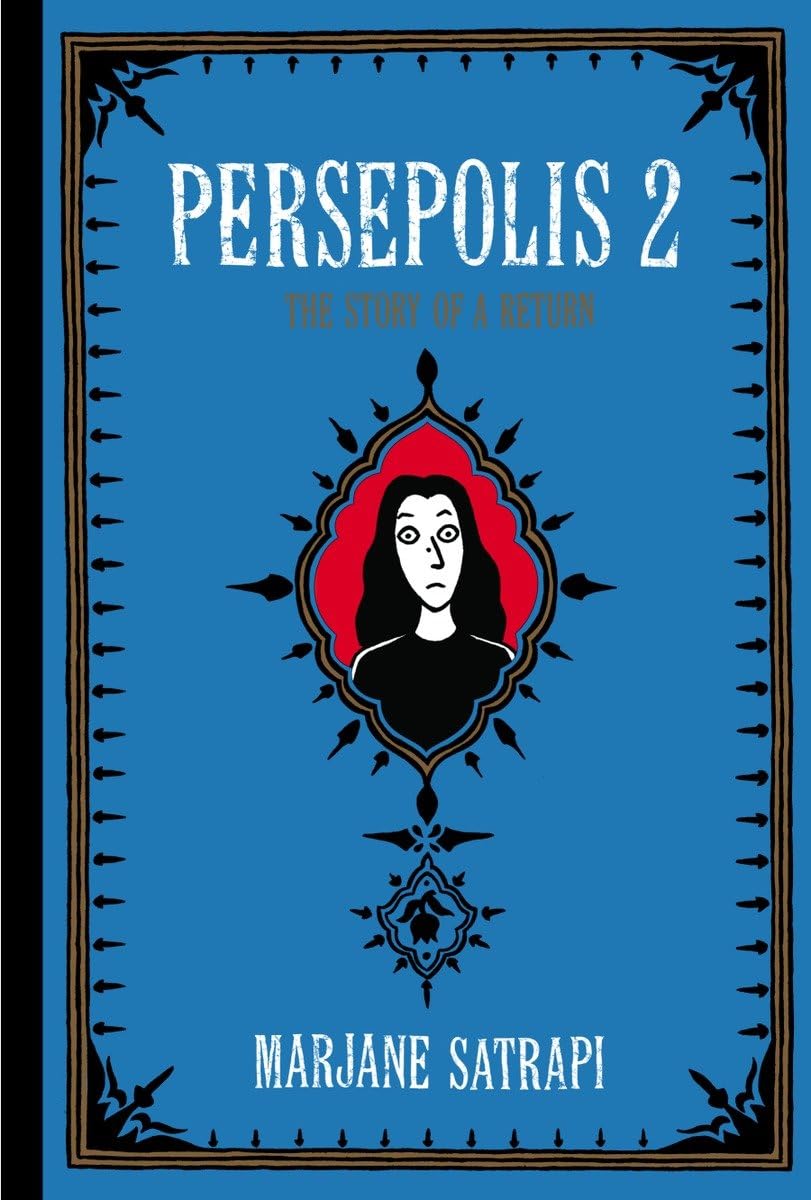
By: Marjane Satrapi (Author), 2004, Paperback

NEW YORK TIMES BESTSELLER • Wise, funny, and heartbreaking, Persepolis is Marjane Satrapi’s acclaimed graphic memoir of growing up in Iran during the Islamic Revolution.
“A wholly original achievement.... Satrapi evokes herself and her schoolmates coming of age in a world of protests and disappearances.... A stark, shocking impact.” —The New York Times: "The 50 Best Memoirs of the Past 50 Years"
One of the New York Times’s 100 Best Books of the 21st Century
In powerful black-and-white comic strip images, Satrapi tells the coming-of-age story of her life in Tehran from ages six to fourteen, years that saw the overthrow of the Shah’s regime, the triumph of the Islamic Revolution, and the devastating effects of war with Iraq. The intelligent and outspoken only child of committed Marxists and the great-granddaughter of one of Iran’s last emperors, Marjane bears witness to a childhood uniquely entwined with the history of her country.
Persepolis paints an unforgettable portrait of daily life in Iran and of the bewildering contradictions between home life and public life. Marjane’s child’s-eye view of dethroned emperors, state-sanctioned whippings, and heroes of the revolution allows us to learn as she does the history of this fascinating country and of her own extraordinary family. Intensely personal, profoundly political, and wholly original, Persepolis is at once a story of growing up and a reminder of the human cost of war and political repression. It shows how we carry on, with laughter and tears, in the face of absurdity. And, finally, it introduces us to an irresistible little girl with whom we cannot help but fall in love.