Sort by:
59 of 1952 products
59 of 1952 products

Debtors have been mocked, scolded and lied to for decades. We have been told that it is perfectly normal to go into debt to get medical care, to go to school, or even to pay for our own incarceration. We 've been told there is no way to change an economy that pushes the majority of people into debt while a small minority hoard wealth and power.
The coronavirus pandemic has revealed that mass indebtedness and extreme inequality are a political choice. In the early days of the crisis, elected officials drew up plans to spend trillions of dollars. The only question was: where would the money go and who would benefit from the bailout?
The truth is that there has never been a lack of money for things like housing, education and health care. Millions of people never needed to be forced into debt for those things in the first place.
Armed with this knowledge, a militant debtors movement has the potential to rewrite the contract and assure that no one has to mortgage their future to survive.
Debtors of the World Must Unite.
As isolated individuals, debtors have little influence. But as a bloc, we can leverage our debts and devise new tactics to challenge the corporate creditor class and help win reparative, universal public goods.
Individually, our debts overwhelm us. But together, our debts can make us powerful.

The #1 New York Times bestselling author of How to Be an Antiracist traces the rise of the authoritarian and xenophobic movements threatening democracies around the globe.

Climate Injustice: Why We Need to Fight Global Inequality to Combat Climate Change
$29.95
Unit price perClimate Injustice: Why We Need to Fight Global Inequality to Combat Climate Change
$29.95
Unit price perFrom one of the world’s most celebrated thinkers on climate change comes a groundbreaking investigation into extreme weather • “I can’t recommend this book highly enough. It will change how you think about the most important story of our time."—JEFF GOODELL, New York Times bestselling author of The Heat Will Kill You First
"Searing in her clarity … Fredi Otto demonstrates, irrefutably, how the North's fossil-fuel-powered “extractivist” economic model drives global climate disruption at the expense of the living world. Climate Injustice prosecutes the case; all it needs now is a courtroom, preferably in The Hague."—JOHN VAILLANT, author of Fire Weather: A True Story from a Hotter World
Climate change does not affect everyone equally. While many scientists focus on studying climate change as a physics problem, Friederike Otto, one of the world’s most renowned climate scientists, sees it as a symptom of the global crisis of inequality, not its cause. In this ambitious, fast-paced book, she offers concrete examples of how extreme weather events caused by climate change reveal uncomfortable truths about the failures of political and social infrastructures around the world.
Comparing eight extreme weather events—including heat waves in North America, floods in Pakistan, droughts in Madagascar, and wildfires in Australia—Otto reveals how climate change is affecting the world’s most vulnerable, whether they are women working on farms in Ghana during heat waves, or elderly people who died during floods in Germany. In particular, Otto examines the Global North’s extractionist view of the Global South, a view that ensures elites are protected while others bear the brunt of the climate disaster.
Climate Injustice shares the stories of real people, shining a light on the real damage inflicted on real lives. Above all, it shows how racism, colonialism, sexism, and climate change are interconnected, and how positive changes on one level can lead to positive effects on another. Authored by the co-founder of World Weather Attribution, a cutting-edge scientific method that pinpointed the role of climate change in extreme weather events for the first time, Climate Injustice offers a groundbreaking view on the fires, floods, heatwaves, and storms that are wreaking havoc at an alarming pace.
Inequality and injustice are at the core of what makes climate change a problem for humanity. Fairness and global justice must therefore be at the core of the solution. Climate justice concerns everyone.

“When truth teller and careful writer bell hooks offers a book, I like to be standing at the bookshop when it opens.” –Maya Angelou
Renowned visionary bell hooks explored the meaning of love in American culture with the critically acclaimed bestseller All About Love: New Visions. She continued her national dialogue with the bestselling Salvation: Black People and Love. Now hooks culminates her triumphant trilogy of love with Communion: The Female Search for Love.
Intimate, revealing, provocative, Communion challenges every woman to courageously claim the search for love as the heroic journey we must all choose to be truly free. In her trademark commanding and lucid language, hooks explores the ways ideas about women and love were changed by the feminist movement, by women's full participation in the workforce, and by the culture of self-help, and reveals how women of all ages can bring love into every aspect of their lives, for all the years of their lives.
Communion is the heart-to-heart talk every woman -- mother, daughter, friend, and lover -- needs to have.

A powerful collection of testimonies from Palestinians facing genocide and displacement in Gaza with hope and resistance.
Displaced in Gaza aims to raise global awareness of how violent displacement has impacted the lives of Palestinians―students, mothers, fathers, grandparents, children, educators, and those who already survived the Nakba of 1948. In Gaza, 2.3 million Palestinians have been subjected to starvation, mass destruction, and targeted killing. Yet they endure.
This book is a commitment to the longstanding Palestinian tradition of storytelling, documenting both the horror of the genocide and the resilience of the Palestinian people. The stories in this collection are not merely accounts of suffering, they are assertions of humanity, resistance, hope, and the unbreakable bond that ties Palestinians to their homeland.
Displaced in Gaza is a collaboration between the American Friends Service Committee and the Hashim Sani Center for Palestine Studies at Universiti Malaya.

"Striking, elegant." – Publishers Weekly, ★ STARRED Review
An activist priest provides sanctuary for an encampment of unhoused people in her churchyard
The housing crisis plaguing major urban centres has sent countless people into the streets. In spring 2022, some of them found their way to the yard beside the Anglican church in Toronto’s Kensington Market, where Maggie Helwig is the priest. They pitched tents, formed an encampment, and settled in. Known as an outspoken social justice activist, Helwig has spent the last three years getting to know the residents and fighting tooth and nail to allow them to stay, battling various authorities that want to clear the yard and keep the results of the housing crisis out of sight and out of mind.
Encampment tells the story of Helwig’s life-long activism as preparation for her fight to keep her churchyard open to people needing a home. More importantly, it introduces us to the Artist, to Jeff, and to Robin: their lives, their challenges, their humanity. It confronts our society’s callousness in allowing so many to go unhoused and demands, by bringing their stories to the fore, that we begin to respond with compassion and grace.

“I’ve never read a book that is as timely, urgent and essential as this one. A battle plan for keeping this nation from falling into fascism.” —Khalil Gibran Muhammad, author of The Condemnation of Blackness
From the bestselling author of How Fascism Works, a searing confrontation with the far right’s efforts to rewrite history and undo a century of progress on race, gender, sexuality, and class.
The human race finds itself again under threat of a rising global fascist movement. In the United States, democracy is under attack by an authoritarian movement that has found fertile ground among the country’s conservative politicians and voters, but similar movements have found homes in the hearts and minds of people all across the globe. To understand the shape, form, and stakes of this assault, we must go back to extract lessons from our past.
Democracy requires a common understanding of reality, a shared view of what has happened, that informs ordinary citizens’ decisions about what should happen, now and in the future. Authoritarians target this shared understanding, seeking to separate us from our own history to destroy our self-understanding and leave us unmoored, resentful, and confused. By setting us against each other, authoritarians represent themselves as the sole solution.
In authoritarian countries, critical examination of those nations’ history and traditions is discouraged if not an outright danger to those who do it. And it is no accident that local and global institutions of education have become a battleground, the authoritarian right’s tip of the spear, where learning and efforts to upend a hierarchal status quo can be put to end by coercion and threats of violence. Democracies entrust schools and universities to preserve a common memory of positive change, generated by protests, social movements, and rebellions. The authoritarian right must erase this history, and, along with it, the very practice of critical inquiry that has so often been the engine of future progress.
In Erasing History, Yale professor of philosophy Jason Stanley exposes the true danger of the authoritarian right’s attacks on education, identifies their key tactics and funders, and traces their intellectual roots. He illustrates how fears of a fascist future have metastasized, from hypothetical threat to present reality. And he shows that hearts and minds are won in our schools and universities—places, he explains, that democratic societies across the world are now ill-prepared to defend against the fascist assault currently underway.
Deeply informed and urgently needed, Erasing History is a global call to action for those who wish to preserve democracy—in America and abroad—before it is too late.

Everything We Thought Was Beautiful: Interviews with Radical Palestinian Women
$19.95
Unit price perEverything We Thought Was Beautiful: Interviews with Radical Palestinian Women
$19.95
Unit price perPalestinian women are an essential—often silenced—part of global struggles for freedom. They are at the forefront of the anti-colonial struggle against Israel’s occupation of their lands, as well as being comrades in intersecting movements worldwide.
This series of interviews with Palestinian women living across Palestine and in the diaspora include a journalist on the front line of resistance against settlers and the Israeli army in the West Bank, a BDS activist, a doctor exposing Israel’s deliberate targeting of medical infrastructure as part of its genocidal assault on Gaza, an organiser who critiques the Palestinian Authority’s repression of social media and those making their voices heard in the diaspora, and others.
Everything We Thought Was Beautiful: Interviews with Radical Palestinian Women broadcasts these women’s struggles in their own words and on all fronts—against colonialism, white supremacy, conservatism, patriarchy, state control—and Israel’s occupation. They discuss their politics, the fight for freedom, and their hope for the future.
Complied by Shoal Collective, a co-operative of independent writers and researchers writing for social justice and a world beyond capitalism, the voices include Ayah Al-Ghazzawi, Lina Nabulsy, Samah Fadil, Diana Khwaelid, Shahd Abusalama, Sireen Khudairy, Lama Suleiman, Shrouq Aila, Rana Abu Rahmah, Shatha Abu Srour, Ghada Hamdan, Mona Al-Farra, and Faiza Abu Shamsiyah with a Foreword by Huwaida Arraf.

We can no longer ignore the fact that fascism is on the rise in the United States. What was once a fringe movement has been gaining cultural acceptance and political power for years. Rebranding itself as "alt-right" and riding the waves of both Donald Trump's hate-fueled populism and the anxiety of an abandoned working class, they have created a social force that has the ability to win elections and inspire racist street violence in equal measure.
Fascism Today looks at the changing world of the far right in Donald Trump's America. Examining the modern fascist movement's various strains, Shane Burley has written an accessible primer about what its adherents believe, how they organize, and what future they have in the United States. The ascension of Trump has introduced a whole new vocabulary into our political lexiconwhite nationalism, race realism, Identitarianism, and a slew of others. Burley breaks it all down. From the tech-savvy trolls of the alt-right to esoteric Aryan mystics, from full-fledged Nazis to well-groomed neofascists like Richard Spencer, he shows how these racists and authoritarians have reinvented themselves in order to recruit new members and grow.
Just as importantly, Fascism Today shows how they can be fought and beaten. It highlights groups that have successfully opposed these twisted forces and outlines the elements needed to build powerful mass movements to confront the institutionalization of fascist ideas, protect marginalized communities, and ultimately stop the fascist threat.
Shane Burley is a writer, filmmaker, and antifascist based in Portland, Oregon.

Part activist memoir, part crash course in Jewish and Palestinian history, Genocide Bad dismantles Zionist propaganda and maps a course towards collective liberation in ten unapologetic essays.
Part activist memoir, part crash course in Jewish and Palestinian history, Genocide Bad dismantles Zionist propaganda in ten unapologetic essays. Drawing connections between Biblical promises and exploding pagers, medieval dress codes and modern-day apartheid, Kern sketches a sweeping history of imperialism with their characteristic blend of far-ranging research, pop-culture insights, and scathing humor.
Kern, a former teacher, journalist, novelist, and book influencer, gained international recognition as an anti-Zionist Jewish activist in the days after October 7th, 2023. At a time when social media was flooded with “I Stand with Israel” posts, Kern started sharing content encouraging their followers to read Palestinian books, learn Palestinian history, and question Western reporting on Palestine—videos which went viral into tens of millions of views.
Despite facing hate messages, death threats, and exile from the Zionist Jewish community, Kern has remained steadfast in their advocacy over the past year. They’ve posted daily videos on Palestinian, Jewish, and colonial history, and they’ve raised over $500,000 in direct aid for families in Gaza—all while navigating the challenges of pregnancy, childbirth, and parenting a newborn. In Genocide Bad, Kern reflects on the life experiences that led them to anti-Zionist activism, while capturing and expanding upon their online educational content.
Kern doesn’t flinch when confronting the horrors of genocides past and present, but there is also tremendous hope contained in these pages—hope that springs from examples of courage and resilience in the face of extreme violence, and from the kinds of resistance that might just lead to our collective liberation.

“No single book is as relevant to the present moment.”—Claudia Rankine, author of Citizen
“One of the defining books of the decade.”—Elizabeth Hinton, author of From the War on Poverty to the War on Crime
NEW YORK TIMES BOOK REVIEW EDITORS’ CHOICE • With a new preface • Fascist politics are running rampant in America today—and spreading around the world. A Yale philosopher identifies the ten pillars of fascist politics, and charts their horrifying rise and deep history.
As the child of refugees of World War II Europe and a renowned philosopher and scholar of propaganda, Jason Stanley has a deep understanding of how democratic societies can be vulnerable to fascism: Nations don’t have to be fascist to suffer from fascist politics. In fact, fascism’s roots have been present in the United States for more than a century. Alarmed by the pervasive rise of fascist tactics both at home and around the globe, Stanley focuses here on the structures that unite them, laying out and analyzing the ten pillars of fascist politics—the language and beliefs that separate people into an “us” and a “them.” He knits together reflections on history, philosophy, sociology, and critical race theory with stories from contemporary Hungary, Poland, India, Myanmar, and the United States, among other nations. He makes clear the immense danger of underestimating the cumulative power of these tactics, which include exploiting a mythic version of a nation’s past; propaganda that twists the language of democratic ideals against themselves; anti-intellectualism directed against universities and experts; law and order politics predicated on the assumption that members of minority groups are criminals; and fierce attacks on labor groups and welfare. These mechanisms all build on one another, creating and reinforcing divisions and shaping a society vulnerable to the appeals of authoritarian leadership.
By uncovering disturbing patterns that are as prevalent today as ever, Stanley reveals that the stuff of politics—charged by rhetoric and myth—can quickly become policy and reality. Only by recognizing fascists politics, he argues, may we resist its most harmful effects and return to democratic ideals.
“With unsettling insight and disturbing clarity, How Fascism Works is an essential guidebook to our current national dilemma of democracy vs. authoritarianism.”—William Jelani Cobb, author of The Substance of Hope
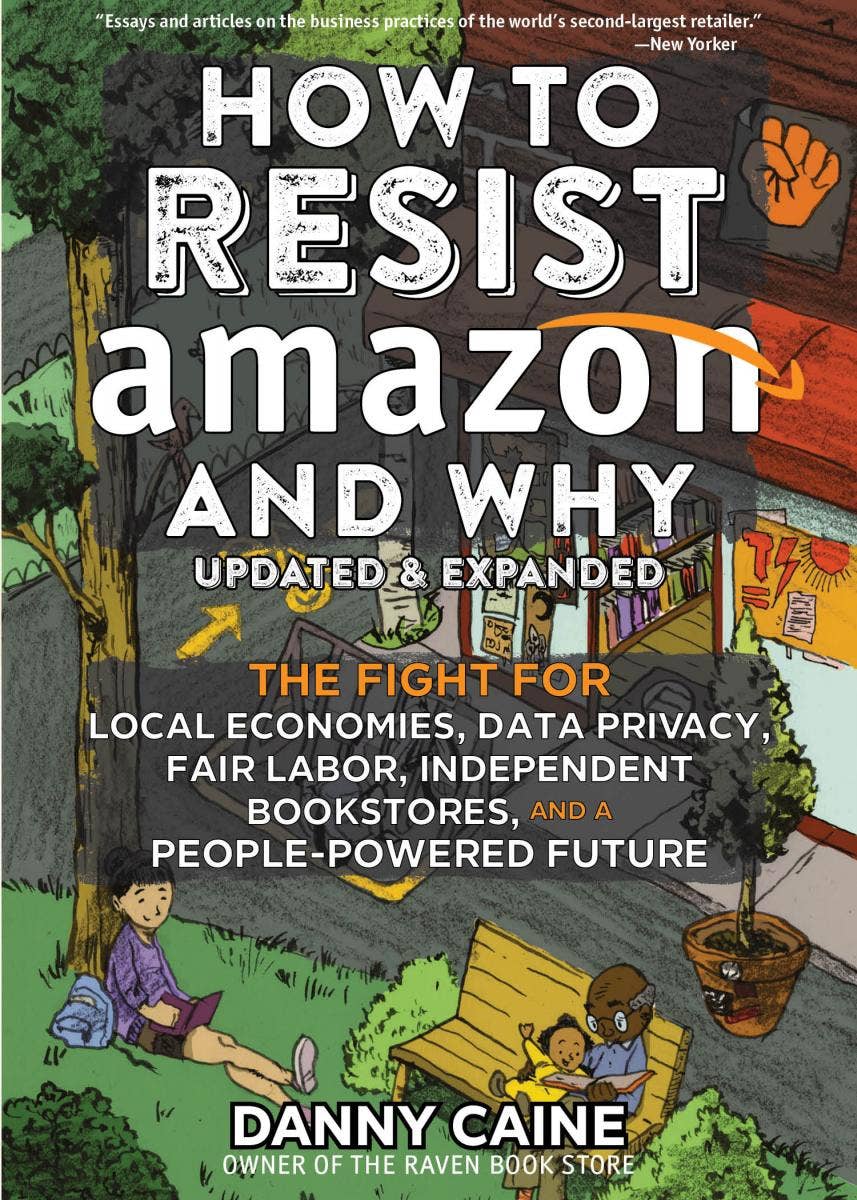
"When a company's workers are literally dying on the job, when their business model relies on preying on local businesses and even their own vendors, when their CEO is the richest person in the world while their workers make low wages with impossible quotas... wouldn't you want to resist? Danny Caine, owner of Raven Book Store in Lawrence, Kansas has been an outspoken critic of the seemingly unstoppable Goliath of the bookselling world: Amazon. In this book, he lays out the case for shifting our personal money and civic investment away from global corporate behemoths and to small, local, independent businesses. Well-researched and lively, his tale covers the history of big box stores, the big political drama of delivery, and the perils of warehouse work. He shows how Amazon's ruthless discount strategies mean authors, publishers, and even Amazon themselves can lose money on every book sold. And he spells out a clear path to resistance, in a world where consumers are struggling to get by. In-depth research is interspersed with charming personal anecdotes from bookstore life, making this a readable, fascinating, essential book for the 2020s"--

How We Get Free (Updated 2nd Edition): Black Feminism and the Combahee River Collective
$19.95
Unit price perHow We Get Free (Updated 2nd Edition): Black Feminism and the Combahee River Collective
$19.95
Unit price perWinner of the 2018 Lambda Literary Award for LGBTQ Nonfiction
“If Black women were free, it would mean that everyone else would have to be free.”
―Combahee River Collective Statement
The Combahee River Collective, a pathbreaking group of radical Black feminists, was one of the most important organizations to develop out of the antiracist and women’s liberation movements of the 1960s and ’70s. In this collection of essays and interviews edited by activist-scholar Keeanga-Yamahtta Taylor, founding members and contemporary activists reflect on the organization’s contributions to Black feminism and its impact on today’s struggles.
This expanded second edition features a new introduction by Taylor and a powerful new interview with Angela Y. Davis.

Starred review from Booklist: “Readers will likely find this anthology difficult to put down.”
What does war feel like? Listen to real people on the ground in Iran. War is not a video game. People's lives are shattered.
An eye-opening anthology from a collective of fifteen different young writers and artists who were going about their daily lives in and around Tehran, while Israel and the United States carried out a bombing campaign to cripple the Iranian nuclear weapons capabilities.
We learn about the nightmare of trying to sleep while bombs are exploding all around you; about the struggle to rescue your beloved cat as you are evacuating your home; about the anxiety of not being able to communicate with your friends and loved ones and learn of their whereabouts; and we hear about the trauma of being forced to return to an abusive home in order to stay "safe."
A searing and honest account of life in Tehran during the U.S. and Israeli attacks of 2025. This book was edited by two Iranian comics teachers, and we have kept all of the editors', authors', and artists' identities anonymous for their safety.

ICE OUT: Minnesota Writers Rising Up is a powerful anthology of poetry and prose responding to the presence of U.S. Immigration and Customs Enforcement (ICE) in Minnesota—and to the human cost of policies that blur the line between law enforcement and occupation. Written in real time by Minnesota writers, poets, immigrants, activists, and witnesses, these pieces capture fear, grief, anger, resolve, and unexpected solidarity as communities confront raids, detentions, and state-sanctioned violence.
Edited with urgency and moral clarity, this collection blends firsthand testimony, lyric resistance, and civic reckoning. Some pieces document specific events; others transform outrage into metaphor, prayer, or defiant humor. Together, they form a record of a place pushed to its limits—and a people choosing empathy over intimidation.
Published in collaboration between Afton Press and Calumet Editions, ICE OUT is both a work of literature and an act of resistance. It speaks to readers concerned with immigration justice, civil liberties, contemporary American politics, and the enduring role of writers in times of crisis.
This book is for readers who believe that words still matter—and that bearing witness is a form of action.